
Enterprise Service Management (ESM)
Enterprise Service Management (ESM) – streamline the entire operation with a common platform
Many organizations still use separate systems for IT, HR, Facilities, Customer Service, Finance, and other business areas. This often results in a complex IT environment with multiple portals, manual processes, and high costs for integration, operation, and management.
Enterprise Service Management (ESM) This changes that by bringing together the organization's services, processes, and workflows on a single platform. It results in better service, greater efficiency, and lower costs, while providing both employees and customers with a significantly better experience.
An organization that successfully implements Enterprise Service Management not only achieves more efficient processes, but also builds a flexible and future-proof platform for continued digital development.
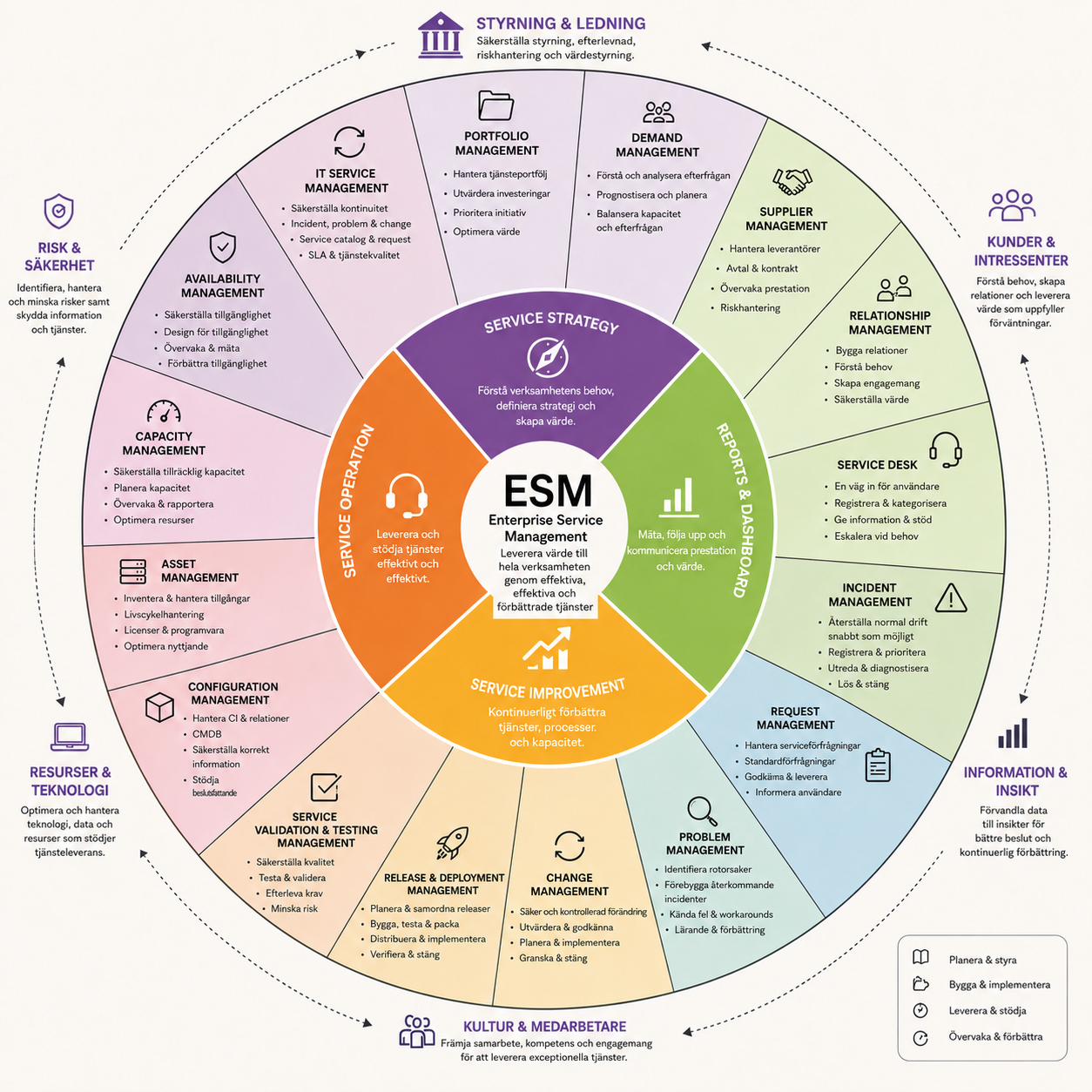
From ITSM to Enterprise Service Management
Many organizations have already established effective IT processes using ITSMand frameworks such as ITIL. Enterprise Service Management builds on this foundation and makes it possible to apply the same approach to the rest of the organization.
By standardizing processes and consolidating various functions into a single platform, the organization can establish a consistent way of working while allowing each business unit to retain its unique processes and needs.
Furthermore, when the entire organization operates on the same platform, it creates entirely new opportunities to automate workflows and streamline processes across organizational boundaries.
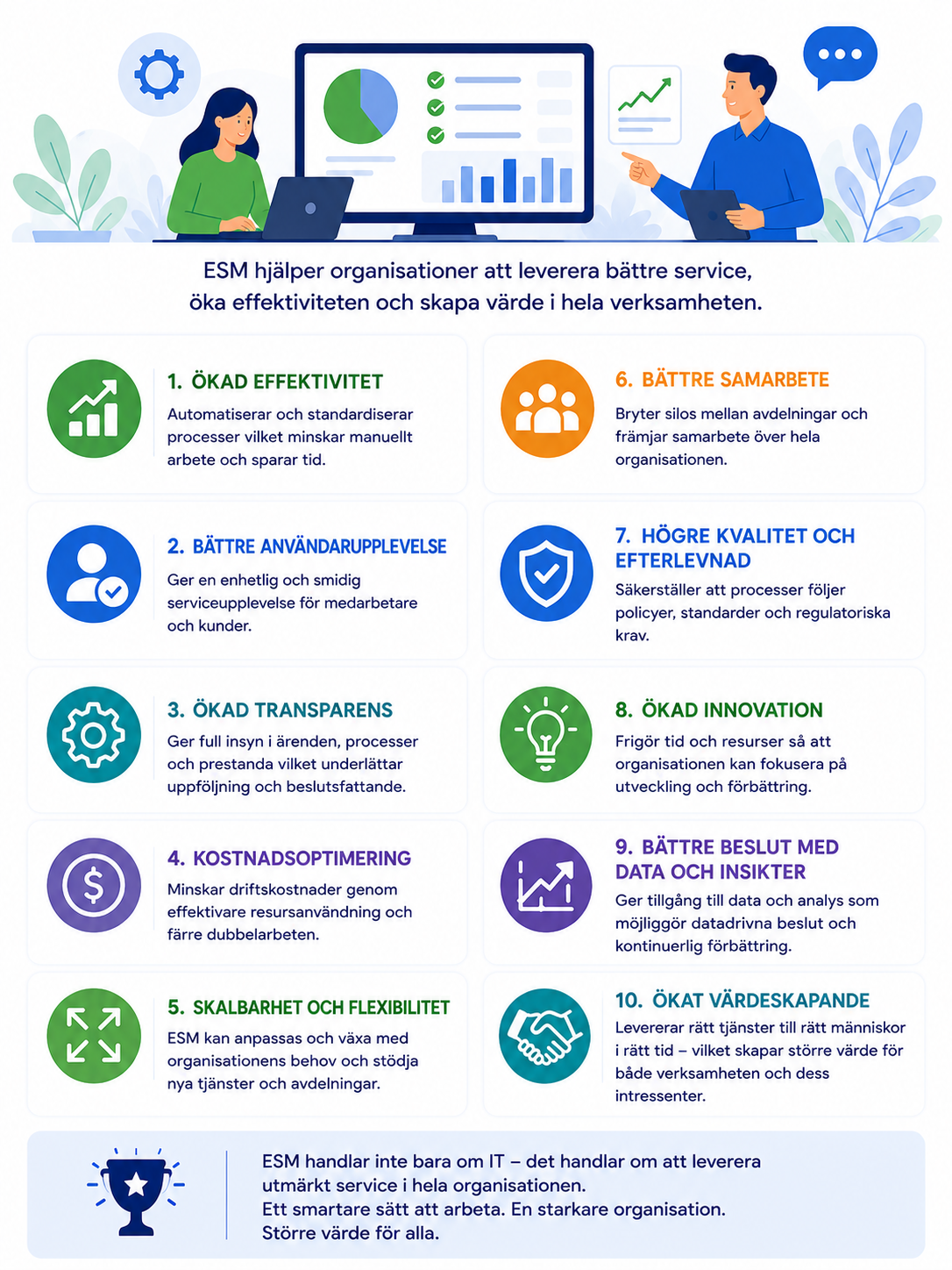
Benefits of Enterprise Service Management:
Fewer systems to manage and maintain
Lower operating and integration costs
Automated workflows between different departments
Shorter processing times
Higher quality and better control over processes
A unified self-service portal for the entire organization
An improved user experience for both employees and customers
Better data and reporting for monitoring and decision-making
What is " Enterprise Service Management (ESM)"?
Enterprise Service Management means that principles, processes, and working methods from IT Service Management (ITSM) are applied throughout the organization—not just within IT.
Instead of each department using its own case management system, a shared platform is used where all business areas can manage their services and processes in a consistent manner.
The result is standardized processes, better collaboration between departments, and increased transparency throughout the organization.
Checklist – Questions to Ask Before Choosing an ESM Platform
-
Ensure that the platform can be used by, for example, IT, Finance, HR, Customer Service, and Facilities Management without each business area needing a separate solution.
-
Can you configure processes, forms, workflows, and portals on your own without extensive development? The easier the platform is to customize, the easier it will be to meet your organization’s changing needs.
-
Explore the possibilities for automating recurring tasks and processes. A robust workflow engine is essential for creating efficient and cohesive processes across organizational boundaries.
-
ESM needs to be able to communicate with the organization’s other systems. Check for support for APIs, integrations, and systems such as HR, finance, CRM, and identity management.
-
Understand how costs are affected when more users, departments, and features are added. Also check whether different modules require separate licenses and whether licensing is based on Named User or Concurrent User.
-
ESM is often a long-term investment. Ensure that the platform can scale from one or two business areas to the entire organization without costs and complexity increasing at an unreasonable rate.
-
When multiple organizations share the same platform, security and access control become especially important. Examine how roles, permissions, data access, and information segregation are managed.
-
Reports from Gartner, Forrester, IDC, and Info-Tech provide a good picture of the vendor's market position and ability to innovate.
-
Read reviews on sites such as Gartner Peer Insights and G2. Focus on both the ratings and the number of verified reviews to get an accurate picture.
-
The ownership structure is particularly relevant when selecting or procuring an ESM tool, as it can affect pricing, product strategy, support, and security, as well as the tool’s long-term viability.
-
Ask the vendor to show you its product roadmap and inquire about how it is investing in areas such as AI, automation, and new integration capabilities. Active product development is key to ensuring that the platform remains relevant.
Here you can read more about Synerity's various product offerings within ESM: